Trump, the Midterms and the AI Stock Crash: What It Means for Your Business
AI stocks had their worst day in over a year after the US midterms. Here is what happened, in plain words, and why it changes nothing about whether AI should answer your customers.
On this page
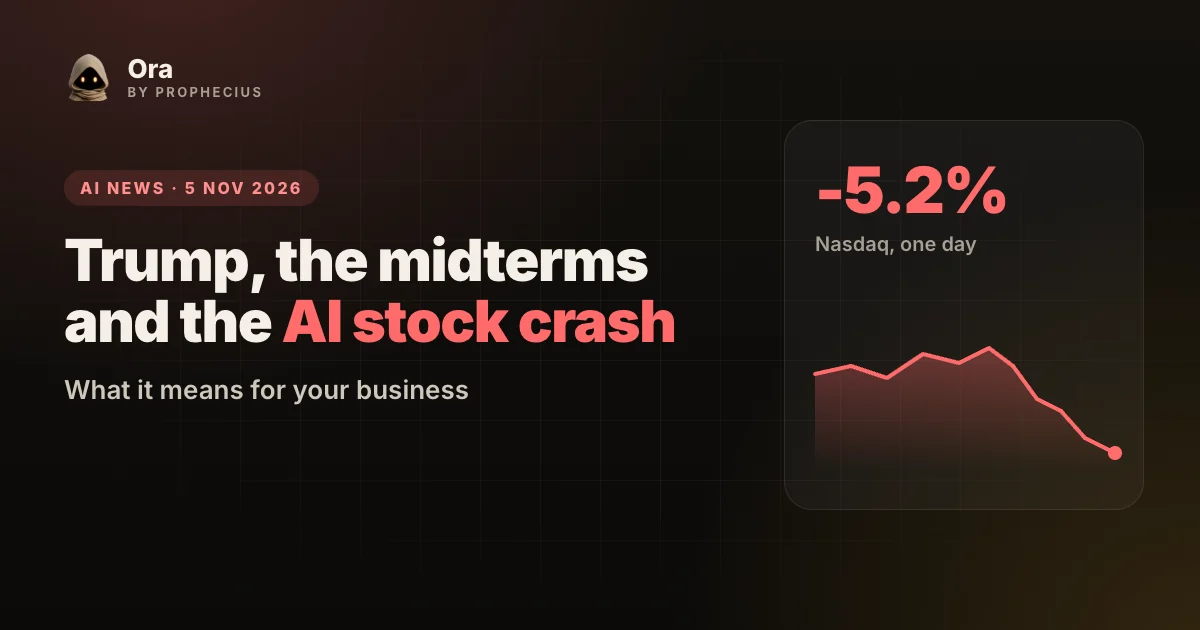
On Thursday, 5 November 2026, AI stocks had their worst day in more than a year. The S&P 500 fell more than 3%, the Nasdaq fell 5.2% and slipped into what traders call a correction, and the biggest names in AI were hit hardest: Nvidia fell about 9% and AMD about 15%, according to the Associated Press.
If you run a business in India and use AI, or are thinking about it, you are probably asking one question: is AI a bubble, and should I stop? This post explains what happened in plain words, and then answers that question.
What happened, in three steps
1. Trump went all in on AI data centres. The President has been one of the loudest supporters of the giant data centres that run AI. He told Americans to "let Data Reign", and said towns that oppose data centres want to stay "backwards and poor".
2. Voters pushed back. Data centres use huge amounts of power and water, and many communities do not want them nearby. In a CNBC survey in late October, 18% of voters named the failure to regulate AI and data centres as a top worry.
3. The midterm results spooked investors. The US midterm elections were held on 3 November. After Democrats did well, investors worried that state and local governments could pause new data-centre building. Fewer data centres would mean fewer AI chips sold, so chip makers fell hardest. Higher borrowing costs, which make these projects more expensive, added to the worry.
There is a second, bigger story in the background: in China, an AI stock boom has already gone bust, wiping out about $480 billion. We explain that in our post on China's AI bubble.
So is AI a bubble?
Here is the part most headlines skip. There are two very different things called "AI".
- AI as an investment. Companies like Nvidia, Microsoft and Google are spending hundreds of billions of dollars on chips and data centres, betting that AI will pay off at a huge scale. Investors are now asking whether those bets were too big, too soon. That question is about share prices.
- AI as a tool. A clinic that uses AI to answer patients on WhatsApp at 11 PM. A coaching centre that replies to every admission enquiry in seconds. A shop that tells customers where their order is without anyone picking up the phone. That is about time and sales, and it pays off the day it starts working.
The stock market can fall 5% in a day. Your customers will still message you at 9 PM tonight.
What the crash does and does not change for you
It does not change:
- Customers still ask 2 or 3 businesses at once, and most go with the first good reply.
- Enquiries still arrive at night, on Sundays and while your team is busy.
- An unanswered message is still a lost sale.
It might change:
- Prices of big AI subscriptions. If AI companies have to show profits sooner, some may raise prices. Pick tools that are clear about what each reply costs.
- Which tools survive. Some AI start-ups living on investor money may not last. Choose a provider that lets you export your data and leads at any time.
- The hype. Less hype is good news for you. It becomes easier to judge a tool by one thing: does it bring in more customers than it costs?
The only AI question that matters for a small business
Forget the share prices. Ask: how many sales am I losing today because nobody replied in time?
Most owners have never measured it. We built a free tool that does: the Lead Leak Audit. Answer six questions, or drop in your WhatsApp chats (they are read on your own device and never uploaded), and it shows how much money slips away to slow replies, after-hours messages, chats nobody answered and missing follow-ups.
For most businesses we see, that number is far bigger than the cost of an AI assistant.
How Ora fits in
Ora by Prophecius is an AI front desk for Indian businesses. It answers your customers on WhatsApp, Instagram, your website, email and phone calls, in their language, using only the information you give it. It books appointments, saves every enquiry as a lead and follows up, and your team can take over any chat at any time.
It does not depend on anyone's share price to do its job. Plans start at ₹4,999 a month, or you can pick only what you need.
Bubble or not, the customer who messaged you last night is still waiting. See how much you are losing, or start with Ora.