China's AI Bubble Burst: Should Your Business Still Use AI?
China's AI stocks lost about $480 billion in four months, and US AI stocks are now falling too. Here is what went wrong, and the simple test that tells you whether AI is worth it for your business.

On this page
For most of 2026, AI was the hottest trade in China. Then it broke. The STAR50 index of Chinese AI and chip companies has fallen about 40% from its July high, wiping out roughly $480 billion, as reported by Yahoo Finance, citing Reuters. One Beijing fund manager called it a "speculative crazy bull" that has now burst.
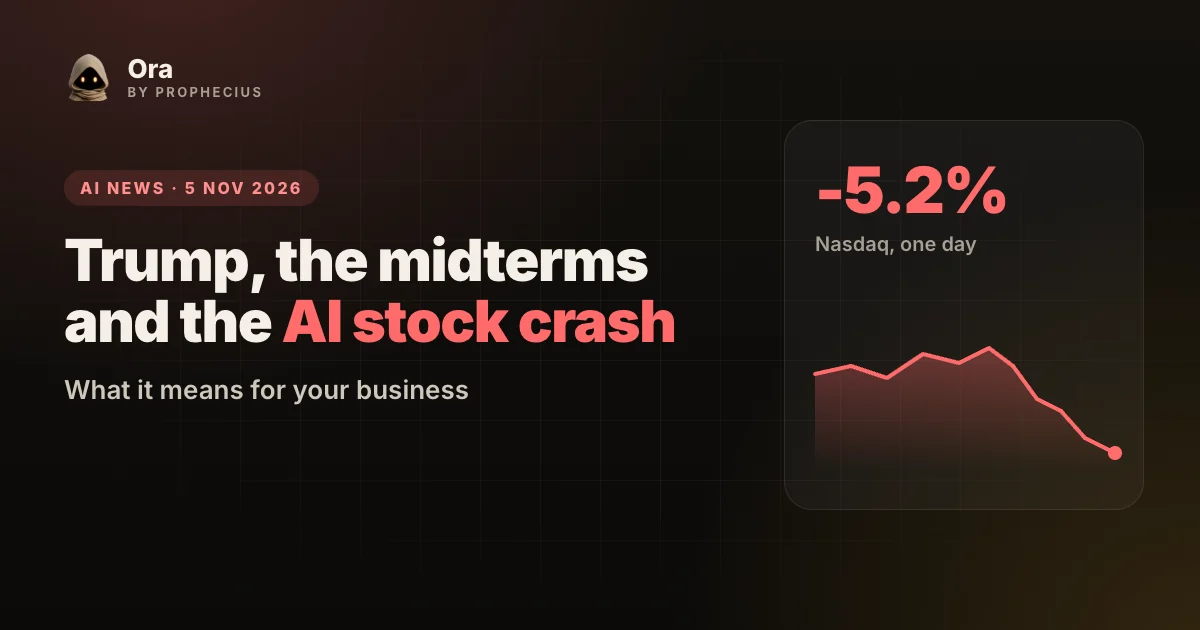
This week the worry reached the US. On 5 November, the Nasdaq fell 5.2% in a single day and Nvidia fell about 9%.
So is AI over? For investors, maybe for a while. For a business owner, the answer is very different. Here is why.
What went wrong in China, in plain words
Prices ran far ahead of profits. Even after the crash, the STAR50 trades at about 100 times past earnings. The Nasdaq 100 trades at about 30 times. Put simply, people paid for years of future profit that had not happened yet.
AI spending ate the cash. Building AI is very expensive. A Rhodium Group study found that the combined free cash flow of Alibaba, Tencent and Baidu went from about CNY 170 billion in 2025 to minus CNY 16 billion in the first half of 2026, as reported by Invezz. They are spending more on AI than their businesses bring in.
Too much of the market rode on one idea. According to Goldman Sachs, AI stocks made up 42% of China's stock market value and 57% of its trading. When the mood turned, there was nowhere to hide.
Is the US next?
Nobody knows, and you should be careful of anyone who says they do. What we do know:
- US tech giants are spending at the same pace. Alphabet expects to spend about $195 to $205 billion on chips and data centres in 2026, and Amazon about $220 billion.
- After the US midterms, investors fear new limits on data-centre building (we explain that in Trump, the Midterms and the AI Stock Crash).
- The next big moment is Nvidia's results on 17 November.
Whatever happens to those shares, notice where the trouble is: in the giant bets on building AI. Not in the businesses using it.
The difference between a bubble and a tool
A bubble is when people pay for a promise. A tool is something that earns its keep this month.
Ask any AI product you pay for one question: what does it do for me this week that I can count?
For a small business, good answers look like this:
- Enquiries answered at night. A salon gets a booking request at 11:47 PM. AI replies in seconds, offers the free slots and books it. Without it, that customer books elsewhere by morning.
- Leads that are not forgotten. Every chat becomes a lead with a name and number, and the AI follows up the next day.
- Time back for your team. The same 20 questions about price, timings and location are answered without anyone stopping work.
Each of these can be counted in rupees. That is the opposite of a bubble.
A 2-minute test for your business
Before you decide anything about AI, find out what slow replies are costing you now. Our free Lead Leak Audit shows it in rupees per month:
- Pick your type of business.
- Answer six quick questions, or drop in a few WhatsApp chat exports (read on your device, never uploaded).
- See your leak score, the biggest leak, and what fixing it would win back.
If the leak is small, you may not need AI yet. If it is large, the stock market is not your problem. Your reply speed is.
Where Ora fits
Ora by Prophecius answers your customers on WhatsApp, Instagram, your website, email and phone calls, day and night, in their language, using only what you teach it. It books appointments, saves every enquiry as a lead, follows up, and lets your team take over any chat.
You can see every conversation and export your data whenever you want. Plans start at ₹4,999 a month, or build your own plan with only the parts you need.
Bubbles burst. Customers keep messaging. Run your free Lead Leak Audit.